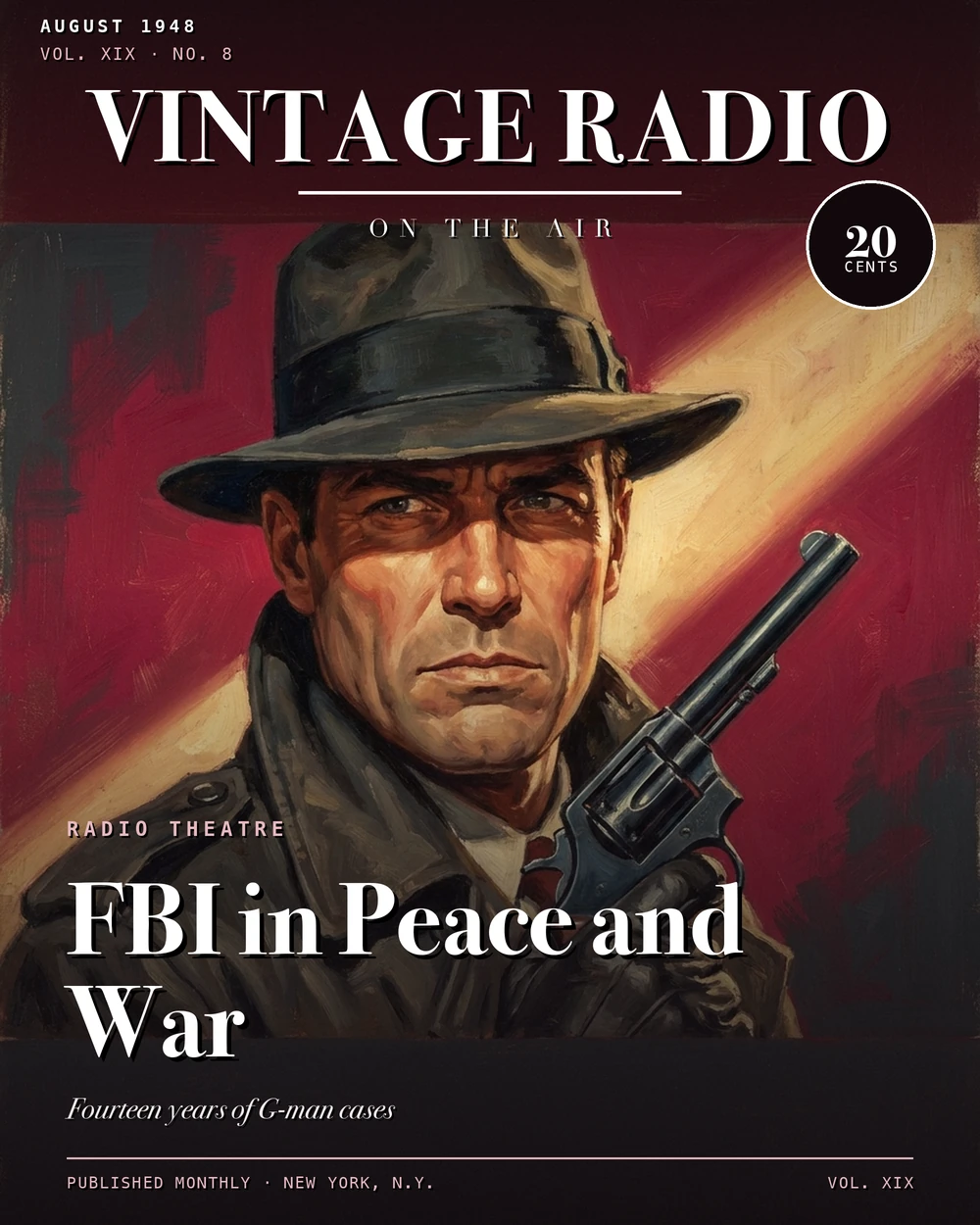
FBI in Peace and War
The Show That Didn't Need Permission
Most radio programs that wanted to dramatize the FBI went hat-in-hand to J. Edgar Hoover's office and worked hard to get official Bureau approval. FBI in Peace and War took a different path. It had no official sanction from the Bureau whatsoever — and for much of its run, it was still a few ratings points ahead of the show that did. That quiet competitive triumph tells you quite a bit about what the program was actually doing right.
The show launched on CBS on November 25, 1944, based on Frederick L. Collins's 1943 book of the same name — a 297-page account of the FBI's wartime work against Nazi and Japanese espionage, published by G.P. Putnam's Sons with a foreword by Hoover himself. Each episode opened with the announcement that what followed was "another great story based on Frederick L. Collins's copyrighted book, The FBI in Peace and War — Drama! Thrills! Action!" Collins, born in 1882, eventually contributed scripts to the show himself, and the idea for bringing the book to radio originated with writer Louis Pelletier, who went on to write many of the episodes.
Despite carrying an end-of-episode disclaimer disavowing any official Bureau endorsement, the show was careful never to present the FBI in anything but the most favorable light. It played down the attractions of criminal life and played up the infallibility of the Bureau — which was, functionally, exactly what the sanctioned competition was doing too. Radio Life compared the two FBI programs in 1947 and found little to choose between them. Both claimed authenticity, both sent their original authors to visit the FBI academy, and both wrapped everything in rousing march music.
How It Sounded
The most immediately recognizable thing about the program was its theme — the march from Sergei Prokofiev's Love for Three Oranges, given what listeners at the time described as a "sassy treatment" by a full orchestra. Arranger Amedeo De Filippi — a Juilliard-trained composer, conductor, and violinist who served as a staff musician at CBS — adapted the march for small symphony orchestra, with Vladimir Selinsky conducting. The result became one of radio's most recognizable signatures, the kind of opening that told you exactly what kind of show you were about to hear before a word of dialogue had been spoken.
De Filippi was no minor figure in American music. Trained under Rubin Goldmark at Juilliard, he joined ASCAP in 1952 and was inducted into the International Institute of Arts and Letters as a New York Fellow in 1962. His arrangement of the Prokofiev march outlasted most of his other work in public memory simply because the show ran so long.
Inside the episodes, the sound design was equally purposeful. Busy, clattering teletype machines ran as a near-constant background element, grounding the stories in the procedural world of law enforcement even when the narrative was focused squarely on the criminals. Sound effects were handled at various points by Ed Blainey, Al Hogan, and Byron Wingett — a rotation that suggests how much of the show's atmosphere depended on that layer of craft. The Lava Soap commercials, which anchored the sponsorship from 1944 through 1950, were themselves a piece of audio design: a deep male voice accompanied by a bass drum rhythmically booming "L-A-V-A! L-A-V-A!" out of an echo chamber. Listeners knew when the break had arrived.
The Stories and How They Were Told
FBI in Peace and War functioned as a virtual anthology series. The only constants were acts of crime and FBI involvement — the specific characters, settings, and situations shifted from week to week. Rackets and swindles were the staple subjects. What distinguished the show's approach was where it put the camera, so to speak: the main characters in most episodes were the criminals themselves, with stories unfolding from their viewpoints rather than from the perspective of the agents working to catch them.
The FBI's presence was embodied through Field Agent Sheppard, played by Martin Blaine, and his enigmatic superior, Mr. Andrews, played by Donald Briggs. These two figures served more as anchors for the Bureau's institutional identity than as developed protagonists — the show's dramatic weight lived in its rotating cast of supporting players and one-episode criminals. Writers Louis Pelletier, Jack Finke, Ed Adamson, and Collins himself supplied the scripts, working within the anthology format across the show's fourteen-year run.
The production budget was modest compared to other prime-time series of the era. The show was made in New York, not Hollywood, and that constraint shaped the kind of talent it drew on: experienced New York radio performers who could do strong work without the resources of a coast production. The stories were compact and efficient by necessity, and that suited the format.
The Cast That Carried It
Martin Blaine, born in Chicago on October 18, 1913, gave Field Agent Sheppard his voice for the run of the series. After the show ended, Blaine moved into film and television work, appearing in The Satan Bug (1965) and The Fortune Cookie (1966) and in episodes of Hogan's Heroes, Bonanza, The Wild Wild West, and Gunsmoke. He had also taken a turn as Doctor Truman "Tubby" Scott in the long-running radio soap Valiant Lady. He died on January 19, 1989, in Cambria, California.
The supporting cast was drawn from the deep pool of New York radio talent and included some of the medium's most reliable performers. Jackson Beck, born July 23, 1912, in New York City, brought the same versatility to this show that made him a fixture across the industry — he's probably best remembered today as the announcer on The Adventures of Superman and as the voice of Bluto in the Famous Studios-era Popeye theatrical shorts. Ralph Bell — born Ralph Scognamiglio on November 27, 1915, in New York City — was another regular whose career extended to CBS Radio Mystery Theatre and Guiding Light. Others in the ensemble included Walter Greaza, Ed Begley, Elspeth Eric, Frank Readick, Rosemary Rice, Harold Huber, Edith Arnold, Robert Dryden, Charita Bauer, Grant Richards, and Alice Frost. Announcers included Warren Sweeney and Len Sterling, with Andre Baruch handling duties specifically during the Lucky Strike sponsorship period.
Betty Mandeville took over as producer-director around 1949, succeeding Max Marcin, who had run the production through the 1940s. Mandeville's tenure was notable in itself — women serving as producer-director of prime-time crime programs during the golden age of radio were rare enough to count on one hand, and she held the position for a sustained stretch of years.
Sponsors, Schedules, and Staying Power
The show's time slot moved around considerably over its fourteen years on CBS, cycling through Saturday, Thursday, Friday, Wednesday, and finally Sunday evenings, and drifting from prime 8:30 and 9:30 slots toward a late-afternoon Sunday position in its final two seasons. Sponsorship shifted too: Lava Soap held the account from 1944 through 1950, followed by Wildroot Cream Oil in 1951 and 1952, Lucky Strike as a summer replacement in 1952, Nescafe in 1953, and Wrigley's Gum from 1954 through 1955.
Through all of that movement, the show held its audience. In February 1955, Time magazine's "The Busy Air" issue reported A.C. Nielsen ratings placing FBI in Peace and War as the eighth most popular radio show in the country, behind Jack Benny, Amos 'n' Andy, People Are Funny, Our Miss Brooks, Lux Radio Theater, My Little Margie, and Dragnet. That ranking, well into the television era, speaks to how effectively the show had maintained its position.
By the episode number sequence visible in surviving recordings — reaching at least episode 402 by June 1953 — the show had aired well over four hundred episodes through that point in its run. The series concluded on September 28, 1958, after nearly fourteen years on the air. A range of episodes survive, including copies transcribed for the Armed Forces Radio Service from the late 1940s and early 1950s, which brought the show to military listeners overseas during its peak years. Jim Cox's 2002 reference book Radio Crime Fighters: More Than 300 Programs from the Golden Age covers the show among its entries in the history of radio crime-detective programming.